Category

Community News

Category

Real talk. Real people. Real consequences. Politics is supposed to be about service, not self-preservation. A politician is meant to be a protector and an advocate for the public. They are trusted to speak up, stand firm, and use their position to create meaningful change for their constituents. That is the responsibility. So why does power so often become the goal?

Most politicians do not enter public life intending to betray public trust. Many step into office wanting to help, to fix broken systems, and to be a voice for their community.

But power has a way of changing priorities.

Over time, the position becomes status. The title becomes identity. The focus quietly shifts from serving the people to protecting the seat.

This is where public service begins to erode.

If you want to understand political behavior, do not just listen to speeches. Follow the money.

Campaign donations, lobbyists, special interests, and political favors all influence decisions. Too often, choices are shaped by who funds a campaign instead of who lives with the consequences.

When money leads, political accountability weakens. Real people pay the price.

Power does not always stop at influence. Sometimes, power feeds on itself.

Control becomes addictive. Authority turns into entitlement. Transparency fades. Ethical shortcuts begin to feel justified.

This is how fraud, manipulation, and corruption in government take hold. It rarely happens overnight. It happens slowly, quietly, and often behind closed doors.

Public trust erodes in the process.

This is the question many avoid asking.

Is power so intoxicating that a politician would say anything to keep their position? Would they ignore facts, silence critics, or refuse to step aside even when doing so would clearly serve their constituents better?

Sometimes the most responsible decision is knowing when to walk away. That choice requires humility, courage, and a willingness to put people before power.

Integrity in politics is rarely rewarded in the short term.

Doing the right thing can mean losing donors, losing party support, or losing reelection. But it also builds something far more valuable than influence. It builds trust.

Leadership and integrity are not measured by how long someone holds office. They are measured by how power is used and whether it is surrendered when necessary.

This is not only a political problem. It is a cultural one.

We often reward charisma over character and sound bites over substance. If we want better leaders, we must demand accountability, transparency, and honesty.

Real people deserve real leadership.

Power in politics is not inherently harmful. Unchecked power is.

When holding office becomes more important than serving the public, democracy weakens. When power is protected at all costs, trust disappears.

A politician’s role is to serve the people. It is not to rule them.

When the answer stops being the people, it is time to question whether power has become more addictive than doing the right thing.

Real talk. Real people. This is what leadership should look like.
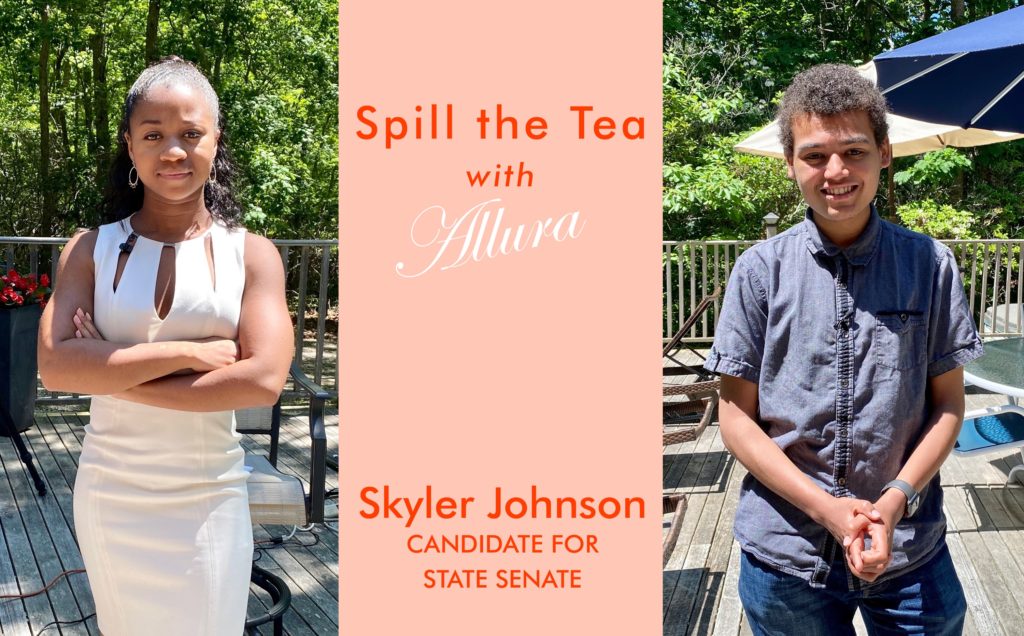
Hamptons Mouthpiece; Spill the Tea – Allura Leggard speaks with New York State Senate candidate, Skyler Johnson to discuss the upcoming election.

Johnson ‘Spills the Tea’ on his plans for healthcare; the environment; education; Police Reform and that was only a fraction of the Bold Plans he has for the future.

Unlike many of the other candidates who have other full-time jobs, Johnson tells us that his full-time job is being a student, continuing to learn more about how he can bring about change and focus on the many issues that concern Americans in the 1st district.

19-year-old Johnson is this year’s youngest candidate running for State Senate.

Johnson expressed that his use of social media and his command for the facts is important to discuss issues that many people in Suffolk County are concerned about.

Johnson is one of five Democratic candidates running this year for Senator Kenneth LaValle’s NY State Senate seat in the First District in Suffolk County. Senator LaValle has held this position for 43 years and decided he will not be running for reelection this year.

Johnson says, one of his most important issues for his campaign is providing everyone in the state with free and quality healthcare. Johnson says this can be achieved by “rebuilding our healthcare system by passing the NYHA, New York Health Act-Including: free testing, treatment, and telemedicine for everyone.”

You can read more about Johnson’s Bold Plans for a Bright Future on his website. https://skylerforsenate.com

Election day is June 23; (Voting polls).
After June 16th, voters may apply in person (over-the-counter) through June 22nd or by Early Voting from June 13-21. Primary Elections POLLS OPEN AT 6 AM – CLOSE AT 9 PM

Register to Vote or update your voter information online: Click here:

Minerva Perez is named Executive Director of OLA of Eastern Long Island

OLA (Organización Latino-Americana) was founded in 2002 as a nonprofit agency committed to promoting social, economic, cultural, and educational development within Long Island’s East End Latino and Hispanic communities.
Through its own programming initiatives and ongoing local collaborations, OLA strives to empower, inform and celebrate our varied Latino and Hispanic communities while building bridges within the larger East End community that help to foster understanding and harmony.
Programs and events have included:
• The Annual OLA Film Festival, in partnership with the Parrish Museum, now in its 13th year • English as a Second Language and Computer Classes for Spanish Speakers
• Arts Education for children
• Leadership workshops for adults
• Educational Forums focused on safety, health, fiscal and legal interests

When Weather Is Not Just Weather

Let’s be honest. We live in a place where the weather likes to keep us guessing, and not in a charming seasonal way. For student athletes, extreme heat and brutal cold are not minor inconveniences. They are real safety risks.

I am writing this not as a worried sports mom in the moment. My daughter was a multi sport student athlete who played three sports throughout the school year and graduated high school in 2017. I am writing this because years later, I still see parents and communities brushing off weather related risks as “part of the game.” It is not.

Extreme temperatures put stress on the body. Heat and cold can cause preventable injuries, exhaustion, and long term health issues. Coaches do their best to manage conditions on the field, but the conversation has to start at home. Parents need to understand the risks so student athletes take them seriously.

The guidelines below come from the New York State Public High School Athletic Association (NYSPHSAA). Policies can be updated, so parents and student athletes should always check the NYSPHSAA website directly for the most current information at nysphsaa.org.

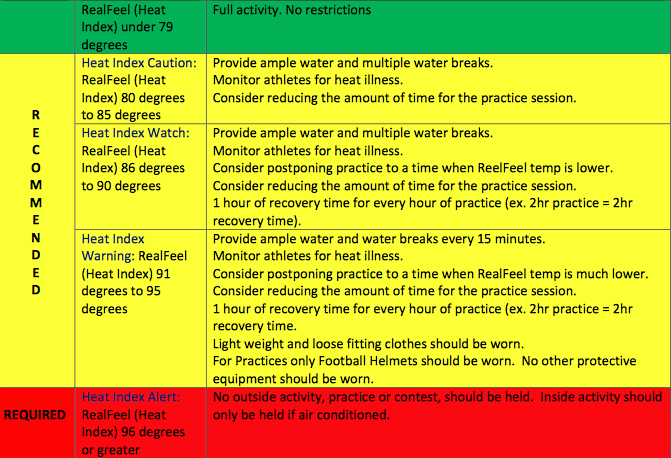
Heat Safety and the Heat Index

The heat index is not just the temperature on your phone. It reflects how hot it actually feels when humidity is factored in. This matters more than people realize.

Modified Heat Alert

When the heat index reaches approximately 88 degrees:

  • Forced water breaks are required every 10 to 15 minutes

  • Student Athletes should wear light colored, loose fitting clothing. Mesh fabrics are recommended

  • Rest breaks in shaded areas are mandatory

  • For football and lacrosse, helmets must be removed during water breaks

  • Athletes not involved in contact drills should not wear helmets

During games, officials are required to allow additional time outs for rest and hydration. Yes, this can slow the game down, and that is intentional. Safety comes first.

Full Heat Alert

When the heat index reaches 95 degrees or higher:

  • No physical activity is permitted in any sport

  • Team meetings are allowed

  • Practices, conditioning, and games are not permitted

This is not overreaction. This is how heat exhaustion and heat stroke are prevented.

Parents should also pay attention to “RealFeel” or “Feels Like” temperatures on weather apps. That is what the body actually experiences.

Wind Chill and Cold Weather Safety

Cold weather can be just as dangerous as heat. It is often quieter about it, but the risks are very real.

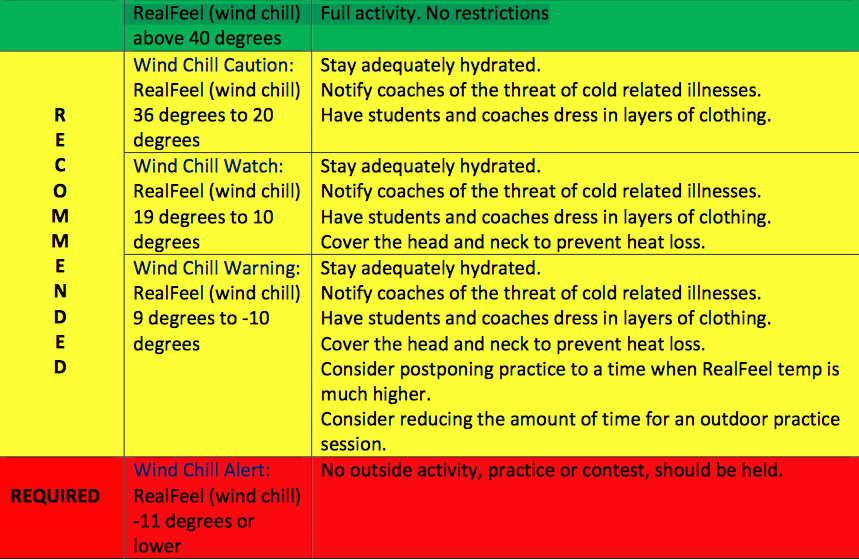
NYSPHSAA uses wind chill calculations to determine safe conditions for outdoor sports. Wind chill measures how cold it feels on exposed skin when wind is factored in.

General Wind Chill Guidelines

  • Above 40 degrees wind chill
    Normal play is permitted. Standard hydration and warm ups are sufficient.

  • 36 to 20 degrees wind chill
    Cold weather caution zone. Extra layers are encouraged and warm up breaks should be frequent.

  • 19 to 10 degrees wind chill
    Wind chill watch. Athletes should be fully layered, with hats and gloves strongly recommended.

  • 9 to minus 10 degrees wind chill
    Wind chill warning. Practices may need to be shortened, modified, or postponed. Frostbite risk increases.

  • Minus 11 degrees or colder
    No outdoor activity should take place. Games and practices should be suspended.

If a student athlete cannot feel their fingers, toes, ears, or face, that is not toughness. That is danger.

What Parents Should Do

This is the practical part that matters most.

  • Make hydration non negotiable in hot weather

  • Make proper layering non negotiable in cold weather

  • Encourage athletes to speak up when something feels wrong

  • Check local weather conditions, including RealFeel temperatures

  • Visit the NYSPHSAA website regularly for updated safety policies

Final Real Talk

It takes a village to raise a child, and it takes adults paying attention to keep them safe.

Extreme weather is not character building. Ignoring warning signs is not grit. No practice or game is worth a preventable injury.

Real talk. Real people. Real responsibility.

HEAT POLICY

WIND CHILL